Context
Banco PAN wanted to become a digital leader in used vehicle financing, Brazil's largest market in this category.
The existing digital product treated financing as a linear, bureaucratic process. In reality, what happened on the dealership lot was completely different from what the system assumed.
I joined as the designer responsible for the project and went on to lead 2 designers from the consultancy (Fjord/Accenture). I led the product alongside 2 PMs, 1 GPM and commercial leadership. The research and strategic framework came from the work I led internally and directly informed the To-Be journey that was implemented.
Research
I started with a CSD matrix to make everything we already knew explicit and map out what we needed to validate. From there, I structured the research into two tracks.
Qualitative: 29 in-person interviews with dealership salespeople, PAN financing representatives and managers in São Paulo, Baixada Santista and the Northeast.
Quantitative: a survey sent to 7 thousand dealers, with 170 valid responses in the first round. In the second round, 155 participants, including 84 dealers and 46 financing representatives from across the country. Another 25 interviews between February and March 2019.
Total: more than 180 participants across qualitative and quantitative research.
From reach to conversations
Quantitative and qualitative research
Less than 3% of the dealers reached answered in the first round.
Key findings
Empowering the front line
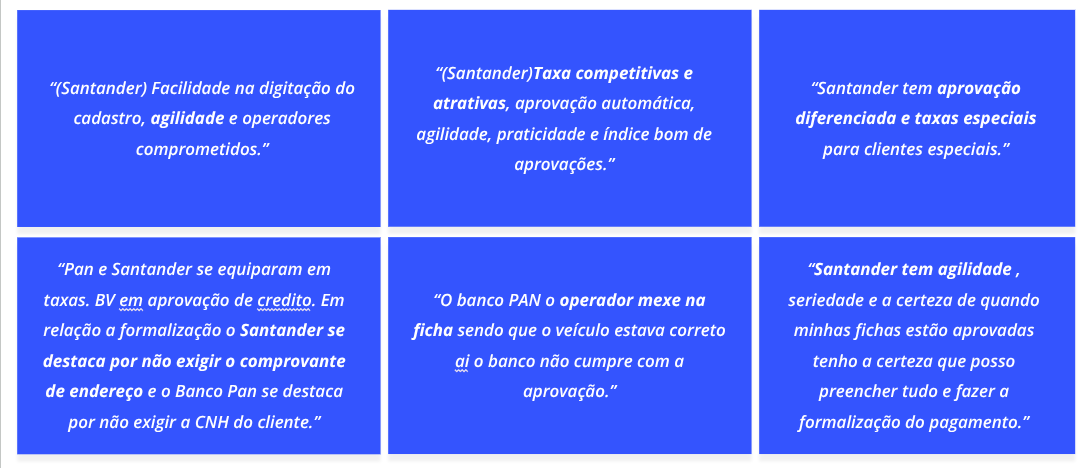
Credit approval perceptions were killing conversion
50% of the day lost to loan finalization
CPF is at the center of everything
Approval rate as dealers perceived it
How much each bank would approve, as estimated by the people selling
The problem wasn't the real rate, it was how accurate the simulator was.
Half of the operators' day went into paperwork
Time attributed to operational tasks
Decision
With more than 180 participants and 9 hypotheses prioritized using a Likert scale, the direction was clear: data and market intelligence first, inventory management next, peripheral features last.
The To-Be journey was organized into 5 phases: Discover, Research and Choose, Learn and Decide, Negotiate and Buy, and Evolve. With 9 service concepts covering the entire ecosystem: dealer, financing representative, sales team, and bank.
The redesign was split into two tracks. New Beetle focused on simplifying operations: insurance waiver, electronic inspection report, digital loan finalization, checkout. Mad Max focused on new value: smart inventory, preliminary loan quotes, recording integration in NPV.
Before
After
The prototype below shows the loan quote flow designed at the time. The product live today at veiculos.bancopan.com.br grew out of this work.
Six years later, I reimagined the experience through the lens I have today.
Impact
The product live today at veiculos.bancopan.com.br grew out of this work. A discovery effort with more than 180 participants, in-person fieldwork across multiple regions, and data-driven hypothesis prioritization that became a real product.
This was the most rigorous discovery work I've led to date. The service map with 9 concepts served an essential purpose: aligning the bank, sales team, and dealers around a shared vision of what digital meant for PAN.
Research scale
participants across qualitative and quantitative research
in-person qualitative interviews
dealers reached through the survey
service concepts mapped
To-Be journey phases
ecosystem actors mapped
Lessons learned
In B2B2C products, the user you see isn't the only one who matters, and sometimes isn't even the main one. The system was designed around the bank's workflow. But on the dealership lot, we discovered that dealers operated in a world of WhatsApp, OLX, and trusted suppliers.
The finding about frontline empowerment had the greatest impact on the product. The PAN financing representative who negotiated and fought for applications was the real competitive advantage. The digital product needed to amplify that dynamic, not automate it to the point of eliminating it.